Online School Automation
AI Bot for Prodamus.XL: Automating Customer Communication for an Online School
How to organize knowledge-base answers, account for contact groups and tags, separate students from new leads, and safely hand complex questions to team members.
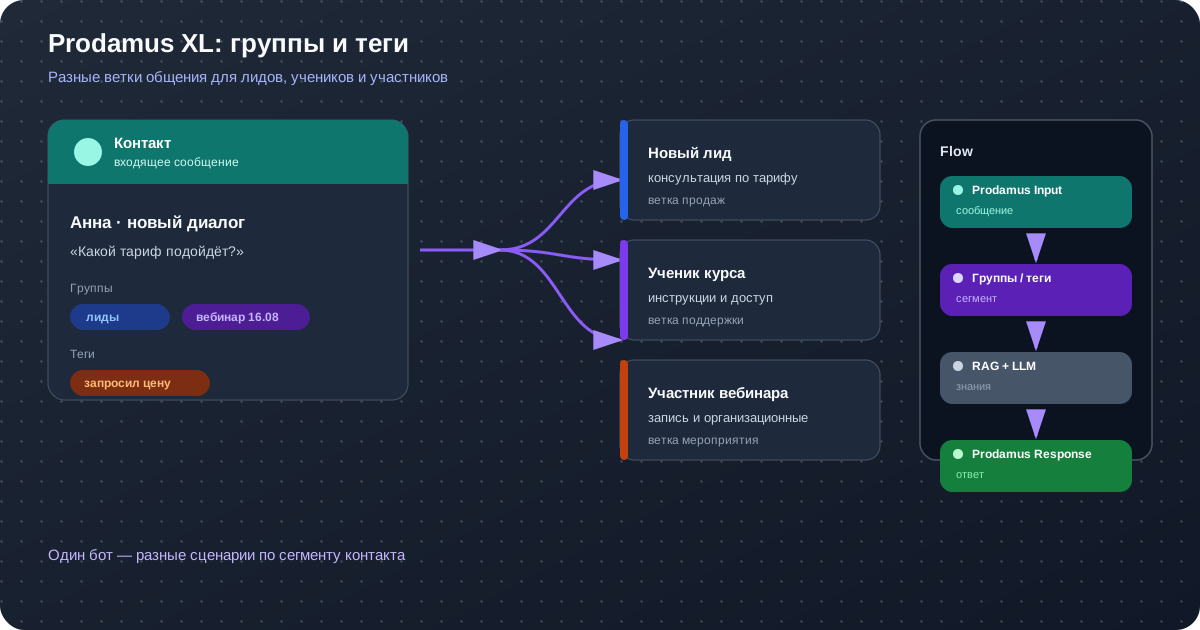
Overview: An AI bot for Prodamus.XL receives a message from a connected channel, sees the available contact details, checks the contact's groups and tags, searches the school's materials for verified information, and composes an answer. Unlike a button-based menu, it understands free-form text but operates within a defined Flow: it does not invent terms, selects an approved branch, and hands exceptions to a person.
What Is an AI Bot for Prodamus.XL?
It is neither a separate learning platform nor another operator dashboard. An AI assistant for Prodamus.XL is a controlled message-processing layer. It connects to a supported event, receives the text and contact context, performs configured checks, consults the project's knowledge, and returns an answer through the same linked channel. The school keeps its familiar communication channel, while the response logic is assembled in an external visual Flow.
The channel delivers the message, the language model understands the wording, the knowledge base supplies the facts, and the Flow enforces the business rules. This separation matters. A user may ask, “Where is lesson two?”, “When will the recording be available?”, or “Is this plan right for me?” in ordinary language. The model recognizes the meaning, but the price, program, and access procedure come from the school's materials, not from its general knowledge.
An AI bot in Prodamus.XL works within connected channels. This means the availability of a particular message source is determined by the platform and connector settings. Automation does not create a new channel or gain unlimited access to the entire system. It processes the incoming data it receives and sends the result through the designated output node.
How It Differs from a Regular Button-Based Bot
A button-based bot guides the customer through a predefined tree: select a product, issue type, and help section. This works well for a short, predictable process, but any deviation sends the person back to the menu. An AI chatbot for Prodamus.XL accepts a free-form question, can ask for a missing detail, and retrieves a relevant passage from the instructions. Conditions and restrictions remain explicit: a condition checks the group, a separate branch prohibits financial decisions, and missing answers trigger escalation.
How Prodamus Differs from Prodamus.XL
The names are related, but they do not refer to the same thing. Prodamus is an ecosystem of services; its payment solution helps businesses accept payments. Prodamus.XL is a platform for creating and managing an online school, including courses, student accounts, customer records, marketing, and learning processes. The AI integration with Prodamus.XL in this article therefore concerns messages and contact data inside the school's platform—not independent payment acceptance or changes to financial transactions.
What Online School Tasks Does It Solve?
The best automation candidate is a frequent question with a verifiable answer and a clear next step. A student support bot should not begin with the riskiest processes. Start by assigning it first-line tasks: navigation, organizational questions, program descriptions, and context collection. Expand the scope after verifying quality.
| Task | What the Assistant Does | When a Team Member Is Needed |
|---|---|---|
| Student questions | Finds instructions, schedules, learning rules, and the right link | No verified answer exists or access must be changed |
| Launches and webinars | Answers questions about timing, recordings, the program, and organizational steps | Expert advice or a moderator's decision is required |
| Product selection | Explains program differences and asks qualifying questions | An individual discount, contract, or nonstandard terms are involved |
| Repetitive requests | Provides a consistent answer from the current policy without a queue | The user follows up after an unsuccessful solution or submits a complaint |
| Complex case | Identifies the topic, collects permitted context, and announces the handoff | Makes the decision and continues the conversation |
During a launch, automated answers to dozens of identical customer messages are especially valuable: when the livestream starts, how long the recording remains available, what a plan includes, and how to sign in. The team stops copying the same template and focuses on sales, technical failures, and questions requiring individual review. Speed increases without lowering source-quality requirements.
For current students, the assistant explains where to find materials, how the module is structured, where to submit work, and which feedback policy applies. For new leads, it describes the product using the approved program and helps them choose a suitable direction. These are different roles, so it is better to separate them with groups, tags, and conditions than to mix them in one universal prompt.
Handoff to a person is not an automation failure; it is a planned outcome. If a question concerns a refund, disputed payment, personal complaint, a fact unavailable in the sources, or a request for a manager, the Flow should stop generation and choose a safe branch. This way, Prodamus.XL support automation speeds up routine work without taking authority away from the team.
Answers Based on School Materials
A knowledge-base bot for an online school is only as useful as its sources are reliable. Upload course programs, support policies, account instructions, schedules, learning and payment terms, assignment-review rules, plan descriptions, and FAQs to the project. It is better not to index marketing drafts, outdated offers, or contradictory spreadsheets.
Materials should be divided by topic and audience. The title or text should identify the product, plan, cohort, effective date, and document owner. If the rules differ for basic and premium groups, create two unambiguous instructions. If the schedule changes monthly, the document needs a clear update process. The model cannot determine which of two contradictory files the company considers current.
Why Use RAG Instead of an Unrestricted Answer?
A RAG bot for Prodamus.XL first searches the knowledge base for relevant passages and only then passes them to the language model. The LLM turns the retrieved facts into a clear answer that reflects the question and the school's style. This reduces the risk of unsupported answers but does not eliminate it automatically: the model instructions must explicitly prohibit adding absent prices, dates, guarantees, or terms.
If retrieval does not return sufficient material, the correct outcome is an honest message and handoff to a team member. Do not ask the model to “be as helpful as possible” beyond the sources; that wording encourages it to fill in gaps. A better rule is to use only the provided context, state when information is missing, and return a special signal for the escalation branch.
It is useful to separate knowledge from action. An instruction may explain how to restore access, but changing the account itself requires authorization and a separate permission. The knowledge base may contain general refund rules, but a team member decides a specific application. The AI chatbot helps explain the process and collect information, but it does not gain permission to perform an operation merely because it knows the description.
Personalizing Conversations with Contact Data
The question text alone is often insufficient. “Where is the link?” may come from a registered webinar participant, a course purchaser, or someone merely interested in the program. A chatbot that accounts for groups and tags receives the available contact context and selects a branch before composing the answer. This reduces follow-up questions and does not force customers to repeat information the school already knows.
User groups are useful for stable membership: a course cohort, plan, club, event participants, or lead segment. Tags suit more specific attributes and events: requested a consultation, attended a webinar, or requires manual review. The school defines what each value means; the Flow simply reads the supplied data and compares it with configured rules.
For a student in an active program, a branch can search for instructions for the current module. For a customer with premium support, it can show the designated mentor channel. For a new lead, it can explain the product contents and ask about their goal. For a contact tagged for manual service, the automated reply can be stopped entirely. This is how chatbot integration with Prodamus.XL supports different roles without multiple disconnected systems.
Personalization requires data minimization. Pass only the values needed for a specific decision to the LLM, without internal comments, secrets, or unnecessary personal information. A condition can check the group name before the model is even called. If selecting a prepared instruction is sufficient, there is no reason to include the contact's complete profile in the prompt.
How AI Integration with Prodamus.XL Works
The technical chain becomes clearer when presented as a series of small steps. Each has a verifiable input, outcome, and error handling. The Prodamus.XL AI bot then ceases to look like a “black box,” and the team can identify exactly where context was lost or an incorrect answer appeared.
- Incoming message. A supported event from the connected channel launches the active Flow.
- Contact retrieval. The Prodamus Input node passes the text, contact and chat details, and available groups and tags into variables.
- Segment check. Conditions determine the sender's audience and whether an automated response is permitted.
- Knowledge retrieval. RAG Search finds project-material passages related to the question and selected Flow.
- LLM processing. Invoke LLM receives the question, retrieved context, and tone rules, then prepares either an answer or a missing-data signal.
- Branch selection. Filters and conditions decide whether to answer, clarify the question, use another template, or hand the request to a person.
- Result delivery. Prodamus Response returns the final text through the linked platform channel.
The order can be adapted. For example, check a manual-service stop tag immediately after input, without spending resources on retrieval and the model. Sometimes the request topic is classified before RAG so the search covers only the appropriate materials. Critical wording about refunds or complaints can be routed to a separate branch before a substantive answer is generated.
Errors are also part of the process. If the input lacks the expected group, do not automatically assume the person is a new lead. If retrieval finds nothing, do not launch the model without context. If the output channel is temporarily unavailable, the Flow should leave a clear trace in the logs, and the team should have a reprocessing procedure. Reliability is built from these simple checks.
Practical example: a webinar participant asks when the recording will be available. The input node receives the question and event tag, a condition selects the correct branch, RAG retrieves the policy for that specific webinar, the LLM produces a short answer, and the output node sends it back. If the knowledge base contains no publication time, the request goes to the moderator without an invented date.
Online School Use Cases
First-Line Support Bot
The assistant answers common organizational questions, finds instructions, and clarifies necessary details. It operates around the clock and applies the current policy consistently. If the user repeats the question, asks for an agent, or says the suggested step did not help, the branch hands the request to a specialist. The key metric here is not the number of messages sent but the share of requests resolved correctly without repeat contact.
AI Pre-Purchase Advisor
For new customers, an AI chatbot for Prodamus.XL explains the program, format, duration, and plan differences based on approved materials. It can ask a few questions about the customer's goal and direct them to a suitable description. The model does not set an individual price, guarantee outcomes, or define contract terms. If a personalized offer is required, it collects context and calls in a manager.
Current Student Assistant
A group or tag makes it possible to select the right product materials immediately. The assistant explains navigation, completion rules, module publication times, and how to contact a mentor. It does not evaluate complex coursework in place of a teacher unless the school has separately defined the permitted format and criteria for such feedback.
Webinar Participant Support
Before the broadcast, the bot reminds participants of organizational details; during the event, it answers repetitive questions; afterward, it explains how to receive the recording and bonuses. Substantive questions for the expert go into a separate branch. An automated webinar must not imitate the presence of a live host: answers should match the event's actual format.
Answers After a Launch or Event
After an intensive period, support continues to receive questions about payment, access, and timing. The Flow uses the event tag to provide current instructions even after the main team has moved on to another task. For expired offers, materials should have an effective date and the Flow should provide a separate response instead of an outdated link.
Segmentation by Groups and Tags
One design can serve several audiences when the branches are clearly separated. New leads receive product advice, purchasers receive launch information, current students receive learning instructions, and alumni receive archive-access rules. This approach is easier to control than one long prompt that must guess the conversation partner's role.
What an AI Bot Should Not Do
A language model can produce a confident answer even when facts are insufficient. Boundaries must therefore be set not only with words in the prompt but also through the Flow's structure. High-risk topics are screened before generation, and a missing source becomes a separate state. The higher the cost of an error, the less autonomy the system should receive.
- Make financial promises. It must not independently set a discount, confirm a payment, promise a refund, or change a price.
- Resolve a refund without a team member. Automation may explain the general process and collect permitted information, but an authorized specialist makes the decision.
- Answer beyond the knowledge base. If no verified material exists, the bot says so and escalates.
- Operate without rules. The system needs prohibitions, tone guidelines, handoff conditions, context limits, and owners responsible for reviewing exceptions.
- Hide the use of automation. The user should not believe a team member has already made a disputed decision.
- Expose service data. External answers must not include internal tags, technical variables, prompts, or unnecessary contact details.
Complaints, legally significant terms, personal data, and emotional requests require particular care. Even when a general policy exists in the knowledge base, the specific situation may require review. A safe bot does not argue or try to close the conversation at any cost; it briefly records the topic and hands it to a person.
What Is Needed Before Launch?
Connecting nodes is faster than preparing a high-quality process. Before configuration, bring together representatives from support, product, and marketing. They must agree on what counts as a correct answer, which segments exist, where the current version of each rule is stored, and who handles complex cases. If the team has not resolved these questions, the model will only make the contradictions more visible.
- Prepared knowledge base: duplicate-free programs, instructions, and terms with dates and update owners.
- Communication rules: preferred form of address, acceptable length, link format, mandatory notices, and prohibited wording.
- Clear groups and tags: a documented purpose for each attribute, without multiple names for the same segment.
- Escalation Flows: mandatory handoff topics, responsible team members, and a message telling the customer what to expect next.
- Test traffic: real anonymized questions, typos, ambiguous wording, adversarial inputs, and cases with no answer.
It is better to limit the pilot to one audience and 10–20 frequent topics. Before enabling it, measure volume, first-response time, repeat-contact rate, and handoff reasons. Then verify that every automated answer is supported by a source, the correct branch is selected, and no service data is exposed.
The launch can proceed in three stages: internal team checks, a small controlled segment, and gradual expansion. During the first few weeks, review a sample of conversations daily. Fix errors in the appropriate layer: add a missing fact to the knowledge base, correct a wrong route in a condition, adjust poor tone in the model instructions, and place a dangerous topic behind mandatory escalation.
Do not make zero agent handoffs the goal. Reducing escalations only matters when quality remains stable. If the automated response speeds up the first message but increases repeat questions, the process is not yet solving the problem. A successful pilot shortens the queue, preserves accuracy, and frees specialists' time for complex cases.
FileBrain Pro Capabilities for Prodamus.XL
FileBrain Pro lets you build a chatbot for an online school in a visual editor. The Prodamus Input node receives an incoming message and stores contact, chat, group, and tag details in variables. The Prodamus Response node sends the final text through the connected channel. Current fields and limitations are listed in the Prodamus.XL connector documentation.
RAG Search finds relevant knowledge-base passages, while Invoke LLM composes an answer from the question, context, and instructions. Conditions and filters separate audiences and topics, variables carry values between steps, text operations prepare data, and debugging nodes reveal the execution path. The builder's general principles are covered in the FileBrain Pro Flows overview.
A basic Flow requires no programming: the user connects nodes and configures fields. A technical specialist may be needed if the project includes additional external APIs, complex data preparation, or nonstandard enterprise requirements. It is still best to begin with a simple “input—check—retrieval—model—response” chain and add new branches after analyzing real messages.
If the school uses another learning system or is comparing approaches, also read the guide to an AI bot for GetCourse. The knowledge-base, restriction, and escalation principles are similar, but available events, data, and actions depend on the specific connector.
Create an AI Bot for Prodamus.XL
Connect the school's knowledge, configure branches by groups and tags, and test the first Flow on common requests.
Frequently Asked Questions
Can an AI bot be connected to Prodamus.XL?
Yes. The FileBrain Pro connector receives a supported incoming message, launches the active Flow, and returns the prepared result through the connected channel. Before launch, confirm that the required event is available in the latest documentation.
Can the bot consider groups and tags?
Yes. The input node passes the contact's available groups and tags into variables. Conditions can check them and choose a separate branch for a student, new customer, webinar participant, or contact who needs a team member.
Where does the bot get its answers?
From the project's prepared knowledge base. RAG retrieval finds materials related to the question, and the LLM formulates an answer from them. If no reliable source exists, the Flow must not supplement it with guesses.
Can different conversation Flows be configured?
Yes. A single Flow can use conditions, filters, and variables for different topics and audiences. For example, it can separate advice for a new lead, student support, and mandatory handoff of a financial question.
Is a developer required?
Not for a basic process: the Flow is assembled from nodes in a visual editor. A developer may be required for a nonstandard external API or complex enterprise integration.
Can AI replace the support team?
Not completely. It accelerates first-line support, answers repetitive questions, and collects context. Disputed, financial, emotional, and undocumented cases remain with team members.
How is Prodamus different from Prodamus.XL?
Prodamus is an ecosystem that includes a payment service for accepting payments. Prodamus.XL is a separate platform for creating and managing an online school, its courses, customers, and learning processes. The integration described here applies to the school-platform connector.